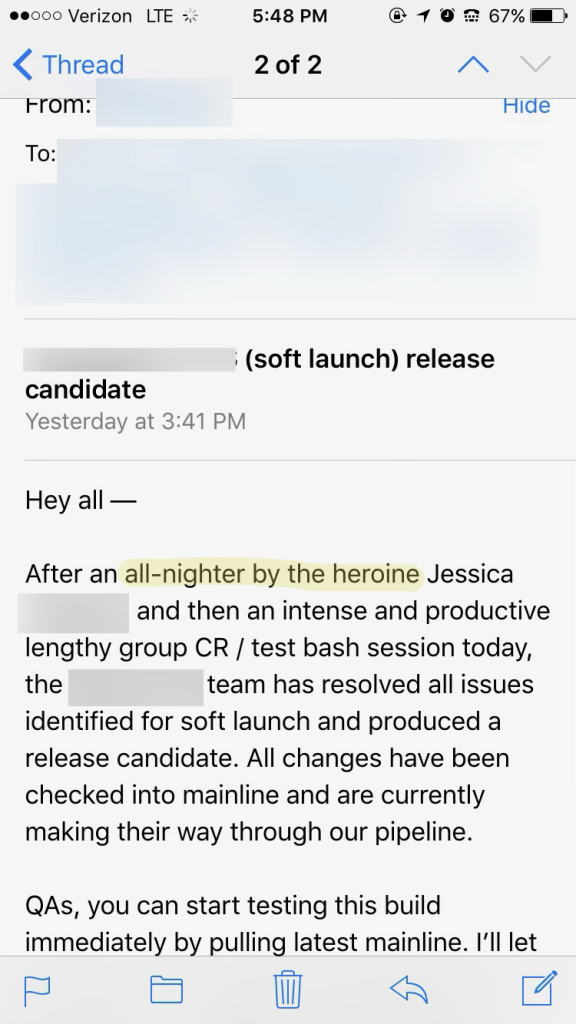
While my first official breakdown didn’t happen until years later, I had a mini episode my first year at Amazon. Our team was blocked from launching the release candidate of our application. Three bugs, nested deeply in the code, were causing a break. This launch was critical to the org and had a lot of eyes on it. The problem wasn’t specific to my feature or code. But somehow I knew I would be blamed if we missed the deadline. I was the junior-most engineer, the expendable one.
So I didn’t go home that night. I kept throwing myself at this bug and got nowhere. It was non-deterministic, meaning it didn’t fail consistently, which made it harder to reproduce and nearly impossible to debug. It was midnight, nobody else was awake, let alone working. I couldn’t call on anyone for help.
If we missed the deadline, I knew what would come next: the whisper that I couldn’t cut it, followed by the performance improvement plan (PIP).
I couldn’t afford to get fired. I couldn’t pay back the signing bonus.
I had to fix the bug but nothing was working.
Nothing was working.
Something in me broke. Something changed in my brain. I wasn’t someone who could handle that kind of pressure.
So I became someone who could.
My brain lit up. Fueled by caffeine, my mind started racing. All that I’d learned in school came to the forefront of my mind: queueing theory, graph theory, concurrency models, the Dining Philosophers problem. I started to work on my hypothesis that all three bugs were caused by the same concurrency issue. I kept working and discovered I was right!
By the time the sun rose, I had a solution.
I pushed the fix.
We made the deadline.
And everyone called it a win and my team called me a hero (even anti-mentor did).
But it wasn’t a win.
It was the moment I stopped recognizing myself, and no one else noticed.